
Key Takeaways
- Higher ed needs a specialized approach to GRC because its proven highest-cost risks are behavior-centric, arising not from transactions or processes, but from complex relationships and expectations across complex and decentralized organizations.
- The ROI of GRC platforms in higher education comes from reduced total cost of risk, derived from the diminution of retained losses through the avoidance of harm and cost in the first place (i.e., preventing even one high-cost incident from spiraling), lower regulatory reporting and investigation costs, greater operational efficiencies, better-managed insurance costs, and protected credit ratings.
- On the purely objective side (without considering the toll these events take on institutional and constituent wellbeing), governance failures, in the form of materialized risks, are financial events, showing up in legal exposure, settlements, fines, insurance volatility, credit risk, and executive time loss.
- The strongest ROI comes from responsive GRC: centralized intake, actionable data, enterprise visibility, well-mapped workflows, cross-functional coordination, and audit-grade documentation.
- Even conservative ROI modeling can justify the investment through avoided (and more efficient) investigations, reduced settlement severity, automated reports, more thorough audit readiness, and improved insurability and credit ratings.
Higher education governance risk is quantifiable. The consequences appear in budgets, audits, insurance premiums, and credit ratings. Institutional financial statements reflect the toll of settlements (or judgments), investigations, regulatory scrutiny and fines, insurance premium and claim volatility, the cost of borrowing, and compliance workload expansion.
Governance, risk, and compliance (GRC) functions – and the software systems that support them – are undeniably essential to combat this risk, but not all institutions manage governance risk the same way.
The financial evidence increasingly favors software and technology in support of a strong culture of operational compliance. Institutions that treat GRC as a strategic technology investment and part of broader institutional digital transformation rather than a purely administrative function experience stronger, more durable financial outcomes.
A closer examination of the ROI reveals why leading institutions are shifting toward technology-enabled risk management.
Contents
Governance Failures Are Financial Events
Every realized risk is, at its root, a governance event, a moment where oversight failed, accountability was diffuse, or institutional will was insufficient to act on what was known or knowable. In a well-governed institution, risk management is not a department or a checklist. It is the operationalized expression of how seriously the institution takes its obligations to its students, faculty, staff, and public trust. When risk is realized, we must ask not only what went wrong operationally, but what the governance system failed to see, failed to own, or failed to act upon.
Legal and Regulatory Exposure Is Escalating
The financial stakes tied to governance breakdowns are clear:
- In 2025 educational institutions publicly reported 41 settlements or verdicts of at least $2.5M.
- Clery Act penalties can reach $71,545 per violation (2025), with a record institutional fine of $14 million in 2024.
- Federal settlements tied to compliance and policy failures are reaching tens to hundreds of millions of dollars.
Even when fines are avoided, weak documentation, inconsistent procedures, and reactive case management increase legal costs and settlement severity. In today’s regulatory climate, presidents and boards could be required to personally certify data submissions and compliance posture, making clear documentation a financial and governance imperative.
The Cost of Compliance Is Already Measurable
Complaint volumes and reporting requirements continue to rise. Department of Education data shows record levels of civil rights complaints. The College and University Professional Association for Human Resources (CUPA-HR) reported that Title IX coordinator or investigator positions have grown by over 30% in recent years. However, CUPA-HR observed that 56% of institutions still lack a dedicated full-time Title IX professional and concluded that this can strain existing staff and dilute the focus needed to ensure compliance.
Compliance demand is growing faster than staffing capacity. Systems must scale where headcount cannot.
Insurance and Underwriting Pressures Are Tightening
Insurance markets are reacting to increased claim severity and social inflation. In higher education, “large loss” thresholds are now commonly defined at $2.5 million or more. Underwriters are scrutinizing documentation, internal controls, vendor oversight, incident response capabilities, and governance maturity. The bottom line is that governance infrastructure affects insurability and the cost of insurance.
For CFOs, that is an ROI conversation.
What Is the ROI of GRC Software in Higher Education?
GRC ROI is derived from reducing the total cost of risk, which flows from diminution of retained losses, reducing the cost of compliance activities, operational efficiencies, and better-managed insurance costs and credit ratings.
1. Diminution of Retained Losses
Reactive institutions treat risk management as crisis response. Well-governed institutions treat it as horizon scanning – embedded in every layer of decision-making. Mature governance is anticipatory. It creates structures that surface emerging risk before harm occurs. This is the goal of enterprise visibility, which is a function of centralized intake of incident reports and centralized capture of rigorous, actionable data.
Consider a simple hypothetical. External investigations require outside investigators, legal counsel, and extensive internal coordination. These efforts quickly become one of the most resource-intensive and unpredictable cost centers for an institution. If a platform meaningfully reduces escalation rates, recognizing harms before they reach crisis-level or preventing even a single major investigation can offset years of software investment.
Similarly, avoiding a single regulatory fine or reducing the severity of a settlement produces immediate financial return. In many cases, penalties are assessed per violation and can accumulate over time, meaning that gaps in reporting or documentation, especially those discovered years later, can carry outsized financial impact.
2. Reduced Cost of Regulatory Compliance
Execution against routine compliance burdens, such as filing the Annual Security Report under the Clery Act, requires large amounts of internal administrative time and frequently the engagement of outside consultants and legal counsel at significant expense. Further, responding to one-off data requests from regulatory agencies, which are becoming more frequent, is extremely expensive in terms of staff time and distraction and outside expert fees. A digital, enterprise-level GRC data system enables the institution to automate much of these processes, substantially reducing the time and cost of routine reporting and responding to regulatory investigations.
3. Operational Efficiency at Scale
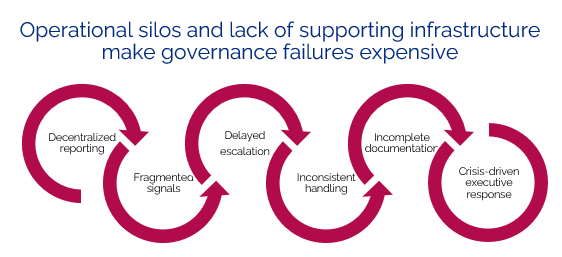
Many institutions still rely on spreadsheets, email workflows, and siloed systems for incident tracking, policy management, risk registers, and documentation. The result is inability to demonstrate work or what was known when, duplication, inconsistent reporting, and high administrative burden.
A GRC platform can:
- Standardize workflows and reduce administrative error
- Improve documentation quality, which can reduce the prevalence of litigation, increase the efficiency with which claims are handled, and lower settlement severity
- Automate evidence collection and workflow routing
- Compress reporting timelines
- Eliminate duplicate data entry across multiple tools
- Provide centralized dashboards for executive reporting
When compliance costs already consume a significant operating budget, even marginal efficiency gains produce meaningful savings.
In a sector facing hiring freezes, budget reductions, and federal funding volatility, efficiency is not optional.
4. Insurance Costs and Credit Ratings
Insurance carriers and credit rating agencies are focused on the strength and effectiveness of institutional internal controls and enterprise risk management. An enterprise-level GRC platform will place powerful tools at three levels in the institution: frontline users (to accomplish their tasks and simultaneously document their work), department managers (to support their teams, balance workload, manage and monitor performance, and perform quality control), and institutional leadership (to identify trends, allocate resources, evaluate internal controls, and provide guidance and oversight). Through significantly enhanced internal controls and enterprise risk management, realistic aims of this platform include improved credit ratings and reduced insurance costs.
Financial exposure can be modeled as the relationship between the likelihood of a risk event occurring and the financial impact of its potential consequences.
GRC software lowers both variables.
- Probability reduction: Earlier pattern detection, consistent processes, creation of memory markers, and centralized oversight reduce the likelihood of escalation.
- Impact reduction: Strong documentation, integrated workflows, and clear audit trails reduce settlement severity and regulatory penalties (which can reach hundreds of millions). Meanwhile, insurers may award premium credits for documented risk management activities.
Not All GRC Tools Deliver the Same ROI in Higher Education
Many GRC platforms were designed for corporate environments where risk is concentrated in:
- Financial controls
- Audit workflows
- Standardized enterprise processes
Higher education is different.
Universities operate in a decentralized environment where the highest-cost risks are often people centered, cross functional, and shaped by both intensifying constituent and stakeholder expectations and increasingly complex and overlapping compliance requirements across federal, state, and accreditor bodies.
These risks include:
- Civil rights complaints (including under Title VII and Title IX, among others)
- Clery reporting failures
- Employee relations matters
- Research compliance
- Accessibility and privacy obligations
Moreover, these risks do not sit neatly inside any single department. They arise in different areas and move across legal, HR, student affairs, research administration, public safety, compliance, and executive leadership as incidents are managed or escalated.
In this environment, optimizing ROI depends on whether the platform can drive several outcomes:
- Allow 360-degree enterprise visibility that bridges silos responsibly
- Create centralized, actionable data and documentation
- Enable line of sight into and earlier recognition of emerging risk
- Support accountability based on the institution’s ability to reliably demonstrate what it knew when and to show its work
- Generate analytics for climate assessment and to understand patterns and trends and anticipate needs
-
Maintain a culture reflecting intentional constituent care and support
Why the Best ROI Comes From Responsive GRC
The strongest ROI comes from what we at Meyestro call Responsive GRC: a holistic system that solves for the people-centric governance, risk, and compliance issues governed by complex rules and regulations in institutions. It addresses the structural conditions that make governance failures expensive: decentralized incident reporting, operational silos, fragmented signals, delayed escalation, inconsistent handling, incomplete documentation, and crisis-driven executive response.
This is the financial consequence of the visibility-accountability gap that digitally empowered governance is designed to address: leadership is accountable for enterprise-level risk, but legacy governance structures (and systems) often limit signals across offices and timelines. When institutions lack practical lines of sight across the enterprise, they find it extremely difficult to identify emerging risk early, to manage and document coordinated and consistent responses in real time, and to later demonstrate accountability under audit, investigation, litigation, or public scrutiny.
In practical ROI terms, responsive GRC moves institutions from hidden signals to centralized visibility, from isolated action to coordinated response, and from crisis under scrutiny to institutional resilience grounded in documented, real-time care and compliance. Those shifts matter financially because they reduce the conditions that drive high-cost outcomes: delayed recognition, inconsistent response, partial documentation,ambiguous ownership or responsibility, and executive time spent reconstructing what happened after the fact.
The responsive model is supported by specific capabilities: unified institutional intake, integrated systems of record, guided, policy-aligned workflows, centralized data, and leadership line of sight. Together, these create a trusted intelligence layer across functions and units, helping institutions in real time to respond to risk systemically, deliver care to their constituents, achieve compliance with policy and regulatory requirements, and support accountability after the fact by being able to show their work.
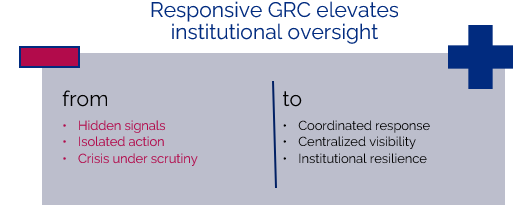
By helping institutions see patterns as they form and intervene before they compound, responsive GRC reduces the frequency, severity, and administrative burden of the events that create the greatest financial exposure.
Calculating the ROI of Responsive GRC
CFOs can frame this investment decision with a simple executive framework:
Step 1: Quantify Current Compliance Labor
- Estimate percentage of operating budget tied to compliance.
- Calculate hours spent on (cost of) data gathering and analysis for reporting.
Step 2: Identify Costs of Status Quo
- Average cost of external investigations
- Legal fees and settlement exposure
- Historical fines or compliance remediation expenses
- Insurance premium trajectory
- Borrowing cost trajectory
- Annual incident volume and rate of escalation to formal investigation
Step 3: Estimate Expected-Loss Reduction
- What happens financially if fewer incidents escalate into formal investigations, legal matters, regulatory actions, or crises?
- What is the impact of avoiding one major fine, judgment, or financial settlement?
- How would improved communication, documentation, and reporting affect litigation prevalence, claim resolution, and settlement severity?
Step 4: Compare 3-Year Investment to 3-Year Avoided Exposure
Include:
- Labor efficiency savings
- Avoided investigation costs
- Reduced settlement and penalty exposure
- Insurance stabilization
- Improved credit rating
- Executive time reclaimed from crisis management
Governance Infrastructure, Not Just Software
Institutional risk management defines risk strategy. GRC software operationalizes it.
Modern institutional risks are interrelated and cannot be managed in silos. Compliance affects reputation. Reputation affects enrollment, funding, and donor confidence. The financial consequences are interconnected.
A responsive GRC platform centralizes risk visibility, supports accountability, and enables institutions to demonstrate oversight across departments, not just within them. More than just the ascertainable financial impacts described above,, this oversight supports the discharge of fiduciary duty for boards and presidents operating under increasing scrutiny by transforming governance from the awareness of risk to the institutional capacity and will to anticipate and respond to it.
Meyestro: Operationalizing Responsive GRC
Meyestro operationalizes this people-centric GRC model through a purpose-built SaaS platform for higher education. Built on Salesforce, Meyestro provides centralized intake, structured workflows, audit-grade documentation, and real-time dashboards. It replaces disconnected reporting tools, spreadsheets, and siloed systems with a unified institutional infrastructure.
The result is digitally empowered governance: consistent and coordinated response, stronger compliance posture, and measurable cost avoidance from the incidents that create the greatest financial and reputational exposure.
Request a demo of Meyestro to explore how centralized intake, data rigor, and cross-functional visibility translate into measurable cost avoidance.

Frequently Asked Questions on the ROI of GRC Platforms
How much does GRC software cost?
Enterprise-level GRC platforms are typically SaaS subscriptions. The investment should be viewed as preventative governance infrastructure that replaces fragmented systems and reduces the total cost of institutional risk.
What is the expected payback period?
Payback is realized through reduced external investigation costs, fewer compliance errors, and operational efficiencies. Preventing or containing a single high-impact failure can offset multiple years of investment, with measurable efficiencies achieved within the first year.
Can GRC software actually reduce total cost of risk?
Yes. By centralizing data and embedding consistent workflows, institutions improve leadership’s line of sight into emerging risk and reduce unforced errors, settlement severity, and audit volatility. Strong governance maturity can also support insurability and credit stability.
What measurable outcomes improve after implementation?
Institutions see compressed reporting timelines, fewer repeat issues flagged by auditors, and more complete, reliable records of how decisions were made. These gains translate into operational efficiency and stronger institutional integrity.
What is the financial risk of not investing in a higher ed GRC platform?
Fragmented systems increase the likelihood of missed signals, inconsistent documentation, and costly escalation. In today’s regulatory and insurance environment, governance gaps can materially increase financial volatility.