
Key Takeaways
Digital transformation in higher education is shifting from technology adoption to governing institutional risk across people, processes, and time.
Institutions are increasingly judged retrospectively under audit, litigation, and public scrutiny, making accessible and reliable institutional records essential.
Traditional enterprise compliance systems struggle in higher education because risk often emerges from complex human situations spanning multiple departments and timelines.
As regulatory obligations expand, fragmented systems, siloed records, and a legacy of avoiding documentation create growing financial and governance risk.
Responsive governance models address this by orchestrating visibility across departments and units, coordinating cross-functional response, coupling disciplined documentation (data capture) to workflow execution, and preserving institutional memory.
The result is a more mature form of digital transformation: earlier and continuous visibility into risk, coordinated institutional response, and durable proof of accountability.
In 2026, a critical governance question for institutions of higher education is not so much how quickly they can adopt new technology, but whether they can use it well to identify, manage, and govern risk coherently across complex rules, high-stakes human situations, and in an environment of constant scrutiny.
Regulatory ambiguity, financial exposure, constituent expectations, and public accountability are converging in ways that test institutional integrity. In response, digital transformation has shifted from an innovation agenda alone to a governance imperative; an imperative that focuses on how institutions define responsibility, coordinate across functional areas, deliver care, achieve compliance, and show their work.
Understanding this shift requires clarity about what digital transformation means in higher education governance. How an institution approaches digital transformation now shapes how it will be evaluated later under scrutiny.
Table of Contents
-
Defining Digital Transformation of Governance in Higher Education
-
Use Cases: What Digital Governance Looks Like Under Scrutiny
Defining Digital Transformation of Governance in Higher Education
In higher education, digital transformation is not simply the adoption of new tools. It is the strategic redesign of how institutions coordinate people, data, and processes to manage risk, demonstrate accountability, deliver care and support to constituents, and execute informed decision-making at scale.
Digital governance is not just about efficiency. While important, perhaps an even more critically important objective is the improvement of risk economics: reducing the long-term cost of fragmentation (a chief source of risk) by investing in clarity, coordination, consistency, and readiness.
Higher education technology leaders have begun to warn openly about the cost of deferring structural change. Writing for EDUCAUSE, Mark McCormack argues that institutions must address accumulated technical debt and resist reactionary technology adoption driven by crisis rather than strategy. His central warning is that patchwork solutions may provide short-term relief, but they erode trust, exhaust staff, and limit an institution’s ability to govern effectively over time.
Responsiveness empowered by a digital infrastructure enables the institution to:
- Break down data and operational silos that impair visibility and obscure risk
- Establish centralized coordination (with appropriate permission guardrails to preserve confidentiality and autonomy) and consistent processes across teams and time
- Establish reliable institutional memory and preserve it, even in environments of rapid change and high turnover
- Produce clear records of what was known when, decisions, and actions
- Allow leaders and boards to see, not infer, the institution’s risk climate
Business Governance Models Don’t Fit Higher Education
Digital governance infrastructure is not new. Enterprises have long used digital systems to automate compliance processes, manage operational risk, and document financial controls. However, the typical enterprise model does not map neatly onto higher education.
Higher education operates in environments shaped by evolving constituent expectations and behaviors, intensifying stakeholder and societal demands, and expanding legal and regulatory obligations. These issues are rarely contained within single domains. They arise and unfold across the institution in all areas and functions, including, for example, civil rights, student affairs, human resources and faculty affairs, athletics, research, facilities, and campus safety.
Traditional compliance tools were not designed to manage this kind of complexity or ambiguity, leaving universities to adapt them or build ad hoc systems, closing critical gaps with (often non-digital) workarounds, or relying on fragmented point solutions.
The Risk Environment is Changing
Risk Has Become Structural, Not Episodic
Higher education has always operated in a complex risk environment. In recent decades, rapid social changes, expanding constituent expectations, intensifying stakeholder scrutiny, and expanding legal obligations have made the risk landscape much more difficult to navigate. Emerging risks have always been difficult to detect, but the consequences and costs of failure to recognize risk patterns early have grown more severe.
Regulatory obligations and government agency actions continue to expand in scope and vacillate in focus. Issues increasingly overlap, often spanning multiple functional areas of the organization. Decentralized authority, the organizational hallmark of higher education, undermines consistency and obscures accountability.
Risk is embedded in everyday operations. Problems often surface late through audits, investigations, litigation, or public scrutiny, not because of a recent failure, but because patterns were missed, signals were disconnected, or past decisions cannot be clearly reconstructed.
The Cost of Risk Is Rising
The financial and operational consequences of realized risk continue to escalate.
Legal defense costs, judgments, and settlements hinge on response quality in real time, including the ability to create memory markers among involved parties, and the institution’s ability retrospectively to demonstrate what it knew when and to show its work. Penalties for Clery failures now exceed $71,000 per violation, and federal program reviews routinely identify multiple violations spanning several years, a pattern that has driven six-to-seven-figure fines for cumulative or systemic noncompliance. The costs of responding to data requests from regulators are typically massive and unbudgeted. Insurers and credit rating evaluators are examining how institutions coordinate across functions, manage performance and consistency in accordance with internal controls, and document their decisions and actions—not just whether policies exist on paper—in determining insurability, premiums, and credit ratings.
At the same time, leadership accountability has intensified. Presidents and boards may be required to attest to processes, certify compliance, and demonstrate effective oversight. Gaps in visibility or coordination likely translate directly into financial exposure, governance strain, and loss of confidence.
The Need for a Different Model: Responsive GRC
National headlines from the past decade demonstrate that the most consequential risks institutions manage arise out of the intersection of complex and evolving rules and complex and unpredictable human behaviors—of students, employees, and community—governed by overlapping regulatory obligations, legal responsibilities, and overarching institutional values.
These environments require governance systems that can support both structural complexity and human-centered response and decision-making.
This is the foundation of responsive governance, risk, and compliance (GRC). Centralized, rigorous data bridge operational silos to give better lines of sight into emerging people-centered risks. Similarly, a systems approach enabled by digital infrastructure supporting trained personnel allows informed coordination of people, processes, and data to effectively manage responses to reports and concerns in diverse units across the institution. Within that, data access controls and permissions preserve departmental autonomy and privacy.
Responsive GRC allows institutions to:
- Bridge operational silos to support 360-degree visibility
- Recognize patterns and emerging risks earlier
- Coordinate cross-functional responses
- Show their work and report on it
- Access real-time analytics to support climate assessments and resource allocation decisions
- Create “memory markers” and strong forensic records that support institutional decisions and actions, reduce the prevalence of claims, and foster the efficient and confident evaluation of claims
Rather than treating documentation as a defensive exercise, responsive GRC embeds data capture into everyday operations. Decisions, approvals, and timelines are recorded automatically as work occurs. This approach recognizes and treats data as the strategic asset that it is.
Care and compliance are transformed from reactive burdens into value-add business partners and continuous signals of institutional health.
Use Cases: What Digital Governance Looks Like Under Scrutiny
Several recurring patterns illustrate how digital governance moves from abstraction to operational reality.
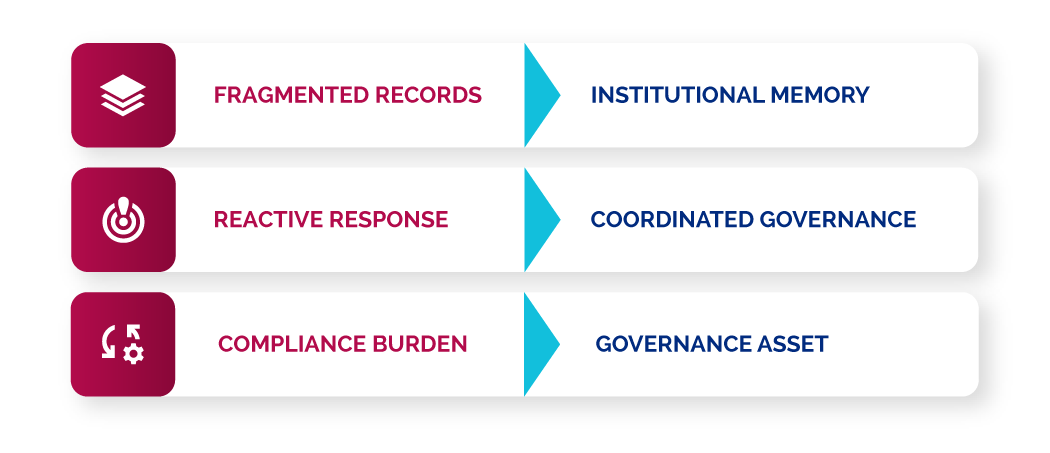
From Fragmented Records to Institutional Memory
High-risk, people-centered incidents frequently span multiple offices, such as student affairs, human resources, legal, compliance, and campus safety, at different times, with each holding partial information. Without a coordinated view over time, institutions can struggle to respond effectively in the moment, manage resolution with appropriate care, and preserve the context needed to show what was known, when decisions were made, and how actions were taken if scrutiny arises later.
Responsive GRC addresses this by centralizing critical information and the digital infrastructure for managing institutional incident response. This creates institutional memory that enables leaders to demonstrate – not reconstruct – the institution’s actions under review.
From Disjointed Reaction to Coordinated Governance
Another common scenario involves crisis-driven response. An issue surfaces publicly or escalates quickly, prompting parallel investigations and inconsistent actions and documentation across departments. The absence of shared visibility makes it difficult to execute effectively and/or demonstrate consistency or intent.
Responsive GRC replaces siloed reactivity with shared situational awareness. Cross-functional teams operate from a common view of facts, roles, and timelines, allowing leadership to govern in real time rather than after the fact.
From Compliance Burden to Governance Asset
In many institutions, compliance has historically lived in departmental silos – meeting minimum defined requirements rather than informing leadership.
Responsive GRC inverts this model. Compliance processes are embedded into daily operations, capturing data and documenting decisions and actions as a byproduct of work. Managers and leaders gain better visibility into emerging patterns of misconduct or noncompliance, risk exposure, and the status of the institution’s responses.
Get the details: Request a demo to learn about real-world responsive GRC achieved by higher education institutions with Meyestro.
A Responsive GRC Model for Digitally-Empowered Governance
Responsive GRC is not solely about technology adoption. It is an elevated governance capability designed specifically for the realities of institutional response in higher education.
Rather than beginning with technology, it begins with “systems thinking” for outcomes: visibility, consistency, coordination, effective care, prevention, and defensibility. Then the technology embodies that structure, and data becomes the fuel to sustain it. As a result, institutional risk becomes more identifiable, manageable, and measurable.
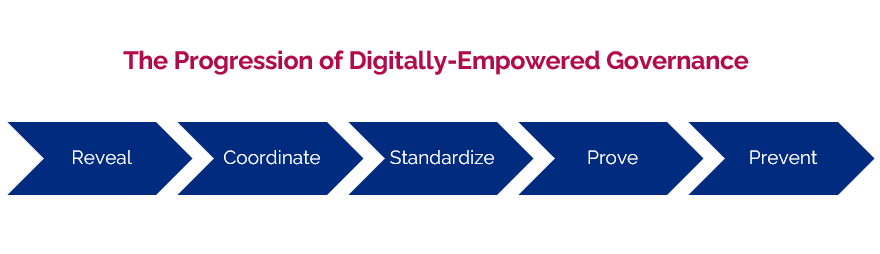
Reveal: Make Risk and Institutional Response Visible
In many institutions, governance risk does not stem from lack of effort, but from fragmentation of efforts. The defining constraint is limited visibility where:
- Relevant personnel lack lines of sight into emerging risks and leadership lacks a consolidated view of cumulative exposure
- Partial records exist in disconnected silos
- Shared responsibilities for outcomes lie in different units without clear ownership responsibility or effective coordination
- Inputs, decisions, and actions cannot be tracked
Visibility brings coherence and confidence to the institutional record that would otherwise strain or break under audit, investigation, or public scrutiny.
Coordinate: Enable Cross-Functional Institutional Awareness
Higher education governance is inherently cross-functional. Student affairs, compliance, HR, legal, academic leadership, and executive oversight frequently intersect within a single matter. However, they’re often siloed in practice, with data too often siloed in systems.
Responsive governance is characterized by:
- Shared situational awareness across roles
- Clear ownership and handoffs
- Role-based visibility and permissions that preserve confidentiality
- Reduced duplication and misalignment
This is how institutions move from siloed reactions to synchronized responses.
Standardize: Establish a Governance Record
Once fragmentation gives way and operational and data silos are bridged, a minimum common enterprise record can be established. This formalizes standards and processes that are too often ad hoc and inconsistent. It represents collaborative decisions on:
- What information must be captured
- What approvals must be documented
- How policy-aligned workflows are triggered
- How timelines are adhered to
- How workloads are managed and personnel perform
Enterprise data centralization and standardization in higher education do not eliminate discretion or autonomy, but protect them. Professional judgment remains central, and is applied within a structure that ensures that actions and accountability can be demonstrated. The outcome is repeatability across departments, time, and case complexity.
Prove: Demonstrate Accountability
In fragmented, reactive environments, documentation is assembled after the fact. In responsive environments, memory markers and proof creation are embedded into the flow of work.
Governance activity automatically produces:
- Records showing what was known when
- Time-stamped decision histories
- Documented approvals, with rationales
- Policy-aligned workflow records
- Traceable communications and actions
Without disciplined data collection, institutions are left with narrative fragments, incomplete records, and manual reconstruction. With it, demonstrating institutional integrity becomes a byproduct of operations rather than a crisis-driven reconstruction exercise. The institution gains the ability to demonstrate care, consistency, and accountability at any point in time.
Prevent: Shift from Reactive Response to Pattern-Based Resource Allocation and Anticipatory Governance
A record of effective responses and incident resolutions over time should create an institutional culture of consequence leading to a preventative impact on incidents of misconduct. Furthermore, when governance workflows are structured and comparable over time, institutions gain insight into patterns that likely would otherwise remain obscured, allowing for:
- Earlier intervention
- Smarter allocation of resources
- Identification of systemic friction points
- Reduction of repeat high-risk scenarios
- Demonstrable care and compliance efforts reported to constituents and stakeholders
Responsive GRC can transform fragmented and reactive risk management into enterprise-level mature, orchestrated, and increasingly preventative governance. Through improved service and outcomes and strategic risk reduction, it can make compliance operations a value-add business partner in the organization, making a positive contribution to the institutional bottom line.
From Digital Transformation to Responsive Governance
In 2026, digital transformation in higher education is not only about innovation optics or the pace of technology adoption. It is fundamentally about whether institutions can act proactively and respond coherently to the real-life situations that put people, trust, and institutional integrity at risk.
At the core of this shift is a simple but demanding expectation: institutions must be able to see risk as it emerges, coordinate responsibility across functional boundaries, and show their work long after decisions are made. Digital transformation succeeds only when it creates durable visibility, continuity, and proof of accountability – capabilities that cannot be retrofitted under pressure.
We believe leaders will be distinguished by how they orchestrate demonstrable responsiveness to the real-world, real-life, fast-changing scenarios confronting their institutions and their people within the context of increasing accountability demands. Technology plays a critical part not as a collection of point solutions, but as governance infrastructure that connects data across silos, embeds policy into everyday workflows, and produces audit-ready proof as work occurs.
This is the role of responsive GRC – and the gap that Meyestro was created to fill.
Purpose-built for higher education, Meyestro is a responsive GRC software platform that brings centralized data, guided workflows, real-time dashboards, and automated reporting into the flow of daily work. It helps institutions coordinate across civil rights, student and faculty affairs, campus safety, HR, and other high-risk functions, enabling clearer accountability, more consistent care, and greater trust among students, staff, regulators, and governing bodies.
To see how responsive GRC is being applied in practice and learn how other institutions are translating digital transformation into durable governance, request a Meyestro demo.

Frequently Asked Questions
Who should own digital transformation in higher education?
Executive leadership, in close partnership with the CIO. While technology teams enable and implement digital transformation, institutional leaders are responsible for setting priorities, aligning stakeholders, and ensuring the work supports broader operational, governance, and risk-management goals.
How does digital transformation of governance actually reduce institutional risk?
Digital transformation of governance implements an enterprise-level digital infrastructure that bridges operational silos through rigorous, centralized data capture as part of embedded workflows – enabling leaders to identify patterns and risks through real-time dashboards and reports.
What does “responsive GRC” mean for higher ed digital transformation?
Responsive GRC is a platform approach to higher ed governance (i.e., operationalized risk management), designed for environments where complex rules intersect with complex human behavior. It is a specialized application and transformation of people-centered care, compliance, and risk management for institutions into enterprise-level centralized, coordinated, and auditable processes.
Do institutions need to replace their existing systems to do this?
No. Most institutions retain their core systems of record—such as student, employee, and financial systems. What changes is the addition of a coordinated response layer that connects data, workflows, and documentation across those systems. Platforms like Meyestro are adopted to sit alongside existing systems, enabling consistency, visibility, and audit-ready governance.
How do boards evaluate whether digital transformation is working?
Boards increasingly look for decision readiness: real-time visibility into risk, consistency in how policies are applied, and the ability to demonstrate governance quality under scrutiny.
What is the most practical next step for institutional leaders?
A good next step is to review real-world use cases. They show how institutions have applied governance-driven digital transformation to reduce risk and maintain trust under scrutiny.